VETRA CASE STUDY
01 · OVERVIEW ONE MONTH · TWO PEOPLE · THREE LIVE PRODUCTS

Vetra AI · Product strategy, research, design, and build

One product was hiding three jobs.

I joined a technical founder as the only designer. In one month, I turned first-time confusion into a product strategy—and carried that strategy through research, three focused landing pages, a redesigned workspace, and production launch.
RoleProduct designer + design builder
TeamTechnical founder + me
Duration1 month
Outcome3 focused products, live
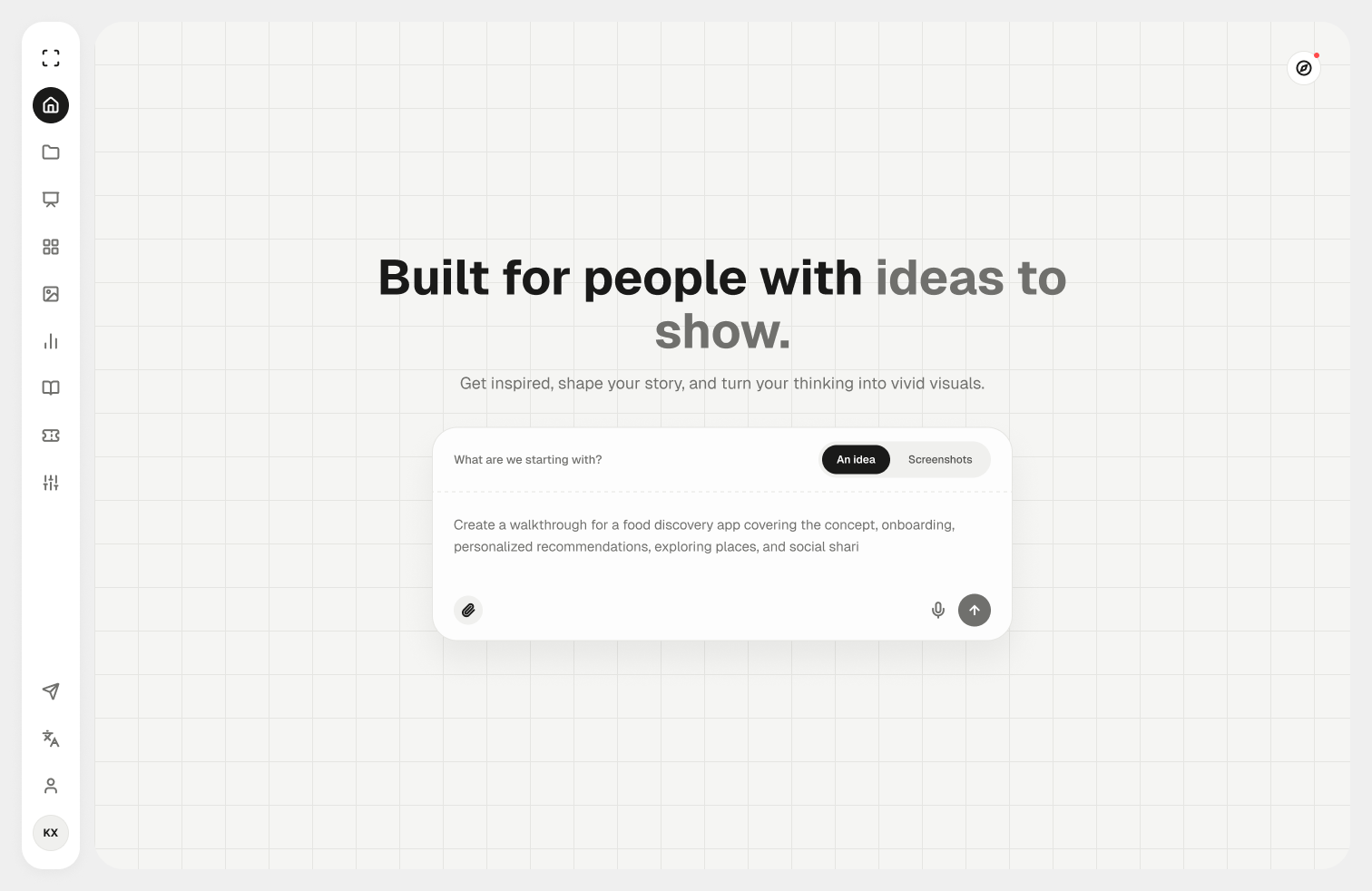
Vetra visual story generation interface
From a broad technical system to focused reasons to care.
02

WEEK 1 · UNDERSTAND

I began by preserving my own confusion.

?

Enter as a beginner

I used the integrated workspace as a first-time startup founder and recorded every hesitation instead of explaining it away.

··········›
WHERE AM I?
WHAT DOES THIS DO?
WHAT HAPPENS NEXT?

Capture friction

Each question became a concrete note attached to the moment where value was interrupted.

··········›
!

Make it shared

The founder answered each friction point, exposing the gap between the builder’s internal model and a new user’s view.
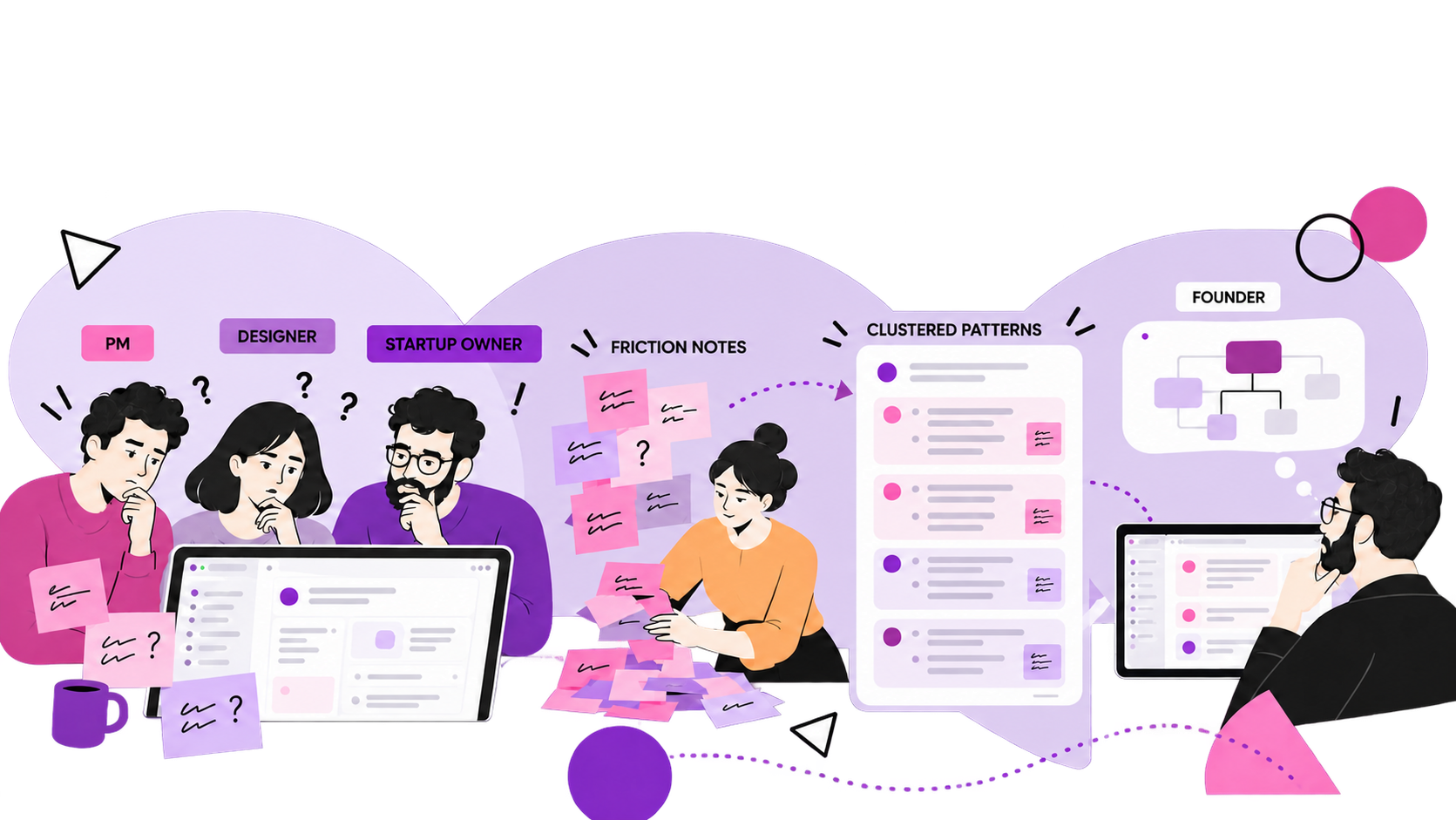
Infographic showing PM, designer, and startup owner friction notes clustered for founder review
Fresh-eyes friction scan. PM, designer, and startup owner questions became clustered patterns and a shared product understanding.
“The builder saw one coherent system. First-time users saw unanswered questions before value.”
03

WEEK 1 · IMPROVE

We fixed the obvious friction before asking the market a bigger question.

The scan was not a usability report left on a shelf.

AI helped cluster repeated questions and propose possible responses. The founder supplied system context. I decided which recommendations were useful, what should change first, and where we still needed evidence.

  • Observed behavior remained the source.
  • AI accelerated organization—not product judgment.
  • The improved product became the research stimulus for the field study.
OBSERVEDFirst-time friction
EXPLAINEDFounder intent
SYNTHESIZEDRepeated patterns
DECIDEDWhat to change now
04

WEEK 2 · LEARN

With limited analytics, I went where the users were.

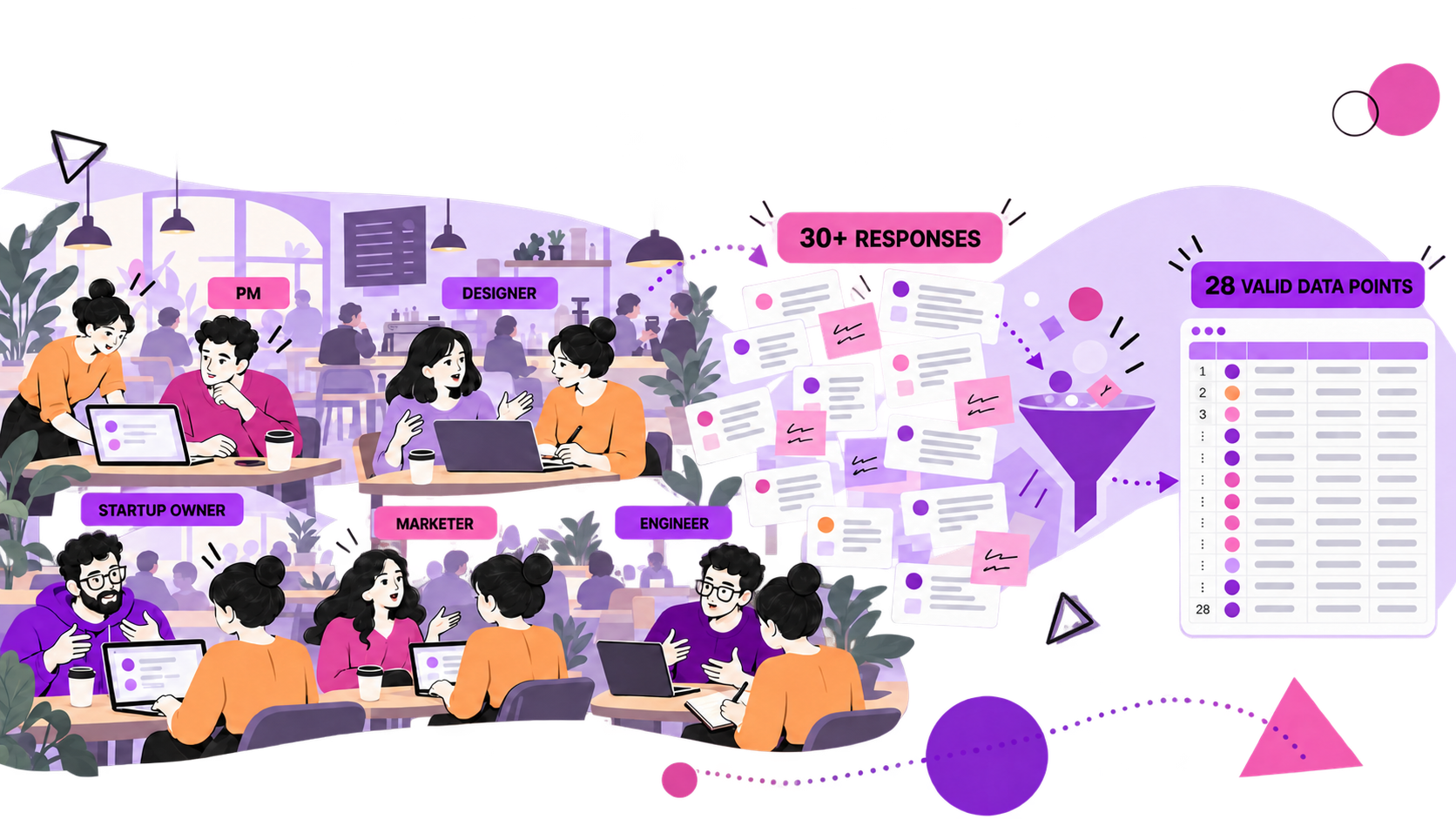
Kate conducting coffee-shop field research across different professional roles, filtering more than 30 responses into 28 valid data points
Coffee-shop field study. More than 30 responses across varied professional roles were screened into 28 valid data points for synthesis.
Why field research?The product was too early for reliable behavioral volume. Direct observation made invisible hesitation visible, while the structured questionnaire made responses comparable.
05

WEEK 2 · SYNTHESIZE

I used AI to interrogate the dataset. Then start human judgment.

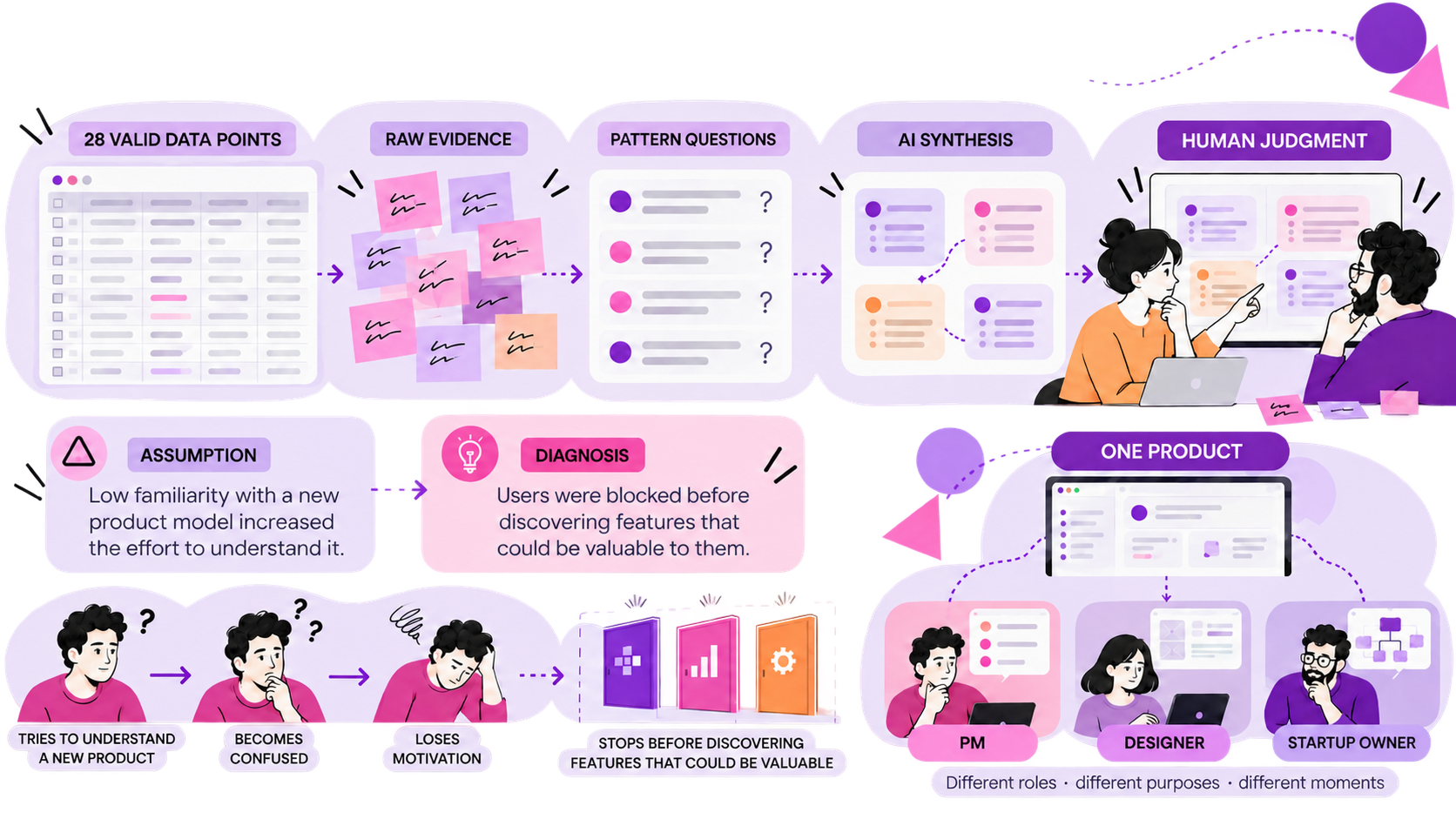
Infographic showing 28 valid data points moving through raw evidence, pattern questions, AI synthesis, and human judgment to the product diagnosis
Evidence to diagnosis. AI organized patterns; Kate and the founder interpreted meaning, tradeoffs, and strategic risk.
THE FINDING

Users were blocked before discovering features that could have been valuable to them.

06

WEEK 2 · DIAGNOSE

Users stopped before discovering potential value.

ENTEROne unfamiliar system
FRICTION“Where am I?”
HIDDENSlides
HIDDENVideo
HIDDENEdit Everything

Working assumption: because this product model was unfamiliar, understanding it required too much effort. Confusion reduced motivation before users reached the core capabilities.

07

WEEK 2 · REFRAME

One product was trying to serve three core roles across different purposes and moments.

PM / LEADER / FOUNDER

Explain the product at a high level

Turn interface screens into a demo video for people who do not understand the product yet.

Demo video
FOUNDER / STORYTELLER

Make a complex idea understandable

Break dense information into bite-sized visual explanations and presentation-ready slides.

Visual slides
DESIGNER / CREATOR

Regain control of a flat visual

Upload an image, separate it into editable layers, then move, delete, or rewrite any element.

Edit Everything
08

WEEK 2 · DECIDE

The strategic fork.

OPTION 1

Keep one integrated product

Find a new mental model that makes three capabilities feel coherent.

  • Preserves the combined technical moat
  • Could create deeper attachment for multi-job users
  • Requires redesign, engineering, recruitment, and repeated testing
  • Feedback remains difficult to attribute
OR
OPTION 2 · CHOSEN

Split into three focused products

Give each audience one clear entrance, promise, and job.

  • Removes discovery complexity immediately
  • Creates cleaner role-specific learning
  • Reduces early-stage development risk
  • Requires three positioning and acquisition strategies
09

THE ARGUMENT

I chose the option that improved the quality and speed of learning.

The expensive ambiguity loop

  1. Invent a new mental model
  2. Re-engineer the integrated workspace
  3. Recruit and test
  4. Observe confusion again
  5. Still cannot isolate feature value

Three cleaner learning loops

One audience → one job → one promise → interpretable behavior
At this stage, precision was more valuable than preserving every possibility.
10

FOUNDER ALIGNMENT

The debate was technology breadth versus learning clarity.

FOUNDER

“These three capabilities form our moat.”

Keeping them together could create a uniquely powerful product.

↔
KATE

“A moat has no value if users cannot reach it.”

Focused products would let us learn what each audience actually valued with less noise and lower investment risk.

DECISION · THREE FOCUSED ENTRANCES
11

WEEK 3 · DESIGN

Strategy became three different reasons to enter.

The technology stayed connected behind the scenes. The front door became specific.

12

DESIGN PROCESS

I explored broadly, then used judgment to converge.

Low fidelitySection order, promise, proof, action
→
Parallel explorationFigma, Claude, Google tools, Codex, handcraft
→
Founder critiqueTechnical truth and business tradeoffs
→
High fidelityOne coherent direction per product

AI multiplied the options. Judgment decided what deserved to ship.

13

WORKSTATION REDESIGN

Different rooms made the user’s location visible.

Before · Canvas modeA slide-like vertical selector did not clarify whether each thumbnail represented a page or a story.
Before · Video modeThe nearly identical layout concealed a fundamentally different creation model.
IDENTICAL SURFACES → AMBIGUOUS LOCATIONDifferent layouts now tell users which room they are in.
14

NEW MENTAL MODEL

Modes organize intent. Conversion connects the rooms.

Choose an intentionA mode picker makes the starting purpose explicit.
Convert between roomsSlides and video remain connected without pretending they are the same workspace.
Reuse across storiesStartup teams can reuse structure while telling different stories.
15

AESTHETIC SYSTEM

A polished output can still be wrong.

Audience fitDoes it feel credible and specific to the intended audience?
5-second comprehensionCan someone explain what it is for and what to do next?
Emotional fitDoes the tone serve the purpose and context?
Brand fidelityCould this only come from this brand?
Compositional coherenceDo hierarchy, rhythm, and tone work as one system?
Publish confidenceWould the user send it—and how much must they edit first?

The implementation remains proprietary. This case study shares the evaluation philosophy, not the private aesthetic rulebook or prompts.

16

WEEK 4 · BUILD

I carried the direction from Figma into production.

01Strategy
02Low-fi Figma
03High-fi Figma
04Figma MCP → Cursor
05Voice-prompted implementation
06Founder review + QA
07Live
The shipped experience turns screenshots and ideas into presentation-ready visual stories.
17

LAUNCH

Three focused products. Three cleaner signals.

What shipped is not the end of the story.

The pivot creates a cleaner learning system: each audience now reaches one promise faster, and future behavior is easier to interpret by role and job.

18

REFLECTION

My role was to make the technology understandable enough to learn from.

I did not treat the founder’s technology as the product strategy. I turned first-time confusion into shared evidence, used field research to locate the real problem, made the tradeoff visible, and carried the resulting direction from positioning to interface to production.

Start with friction.Confusion is evidence when it is captured precisely.
Optimize the learning system.Cleaner signals can be more valuable than broader scope.
Use AI for breadth, not accountability.Judgment still owns the decision.
Return to the beginning ↑